Jesus–the multitudes relationship
Don't Leave God Alone: How to Get God's Attention, Remain in His Presence, and Even Change His Mind to Make a Difference in Your WorldJesus–the multitudes relationship is defined by a striking tension between Jesus Christ’s legitimate desire for solitude and the multitude’s refusal to abandon the hope of receiving help from Him. The relationship becomes a central illustration of persistent faith: the people pursue Jesus Christ through weariness and inconvenience, while He responds to their hunger with compassion, healing, and blessing rather than rejection.
Grief, Solitude, and Unexpected Pursuit
Jesus Christ’s withdrawal begins in grief. News reached Him that John the Baptist, His cousin and the forerunner of His ministry, had been beheaded. John the Baptist was the one who had declared Jesus Christ’s identity and purpose, proclaiming Him as the Lamb of God who takes away the sin of the world. The loss therefore carried both personal sorrow and the disappearance of a figure who had understood and publicly announced His mission.
After John the Baptist’s body had been buried, the disciples came and told Jesus Christ what had happened. He departed by boat to a deserted place by Himself, seeking a period of quiet rather than immediately returning to public activity. The withdrawal is portrayed not as indifference to people but as a human need for space to absorb devastating news and gather His thoughts. The multitude, however, learned where He had gone and followed Him on foot from the surrounding cities.
The Multitude’s Determined Faith
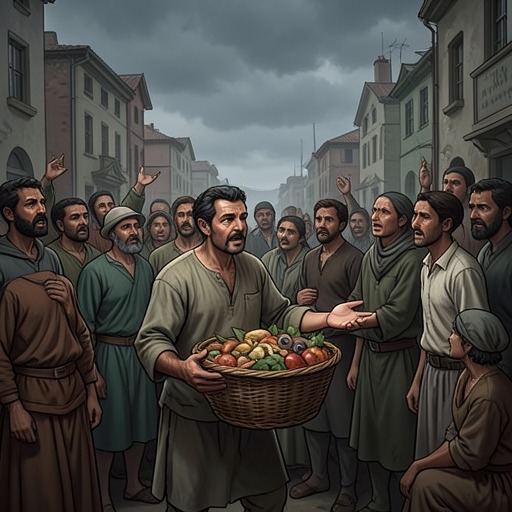
The multitude’s pursuit is described as active faith rather than passive interest. The people heard about Jesus Christ and did not respond with doubt. They followed Him physically, choosing the more demanding route on foot instead of an easier means of travel. They continued through the day until evening, accepting exhaustion and the inconvenience of distance because they believed that reaching Him mattered more than preserving their comfort or schedule.
This persistence gives the crowd a distinctive place in the book’s teaching. Their faith was not reduced to an inward conviction; they placed action behind what they had heard. They risked fatigue, faced the possibility of difficulty, and continued after the ordinary time for seeking help had passed. The narrative treats their willingness to spend the day pursuing Jesus Christ as evidence of a hunger strong enough to overcome the temptation to quit.
The crowd’s determination also contrasts with the repeated temptation to leave God alone when an answer does not appear quickly. Elsewhere, the book presents persistence as the practice of continuing to pray until the promised answer is manifested rather than stopping when temporary relief fails to arrive. In this framework, the multitude embodies the same refusal to surrender: it keeps moving toward Jesus Christ until its need receives a response.
Compassion Overrides Withdrawal
When Jesus Christ saw the multitude, He did not send the people away because He had intended to remain alone. The account says that He was moved with compassion toward them and healed their sick. The decisive movement in the relationship is therefore from withdrawal to engagement, and the transition is caused by what He sees in the people before Him: a great multitude that has followed Him with determination.
The book interprets this response as a form of gracious change in immediate intention. Jesus Christ had gone into the wilderness to be alone, yet the people’s persistence caused Him to respond to their needs. His compassion proves stronger than His desire for seclusion at that moment. The crowd receives not a rebuke for interrupting His solitude but the blessing it had pursued: access to His healing power.
This does not portray Jesus Christ as indifferent to personal boundaries or as incapable of weariness. Rather, it emphasizes the depth of His responsiveness to people in need. Even while carrying grief and seeking quiet, He could not ignore a hungry multitude. Their pursuit revealed a need that called forth mercy, and the encounter turned their determination into healing.
A Pattern of Response and Blessing
The relationship is used as a pattern for prayer. The book urges readers to bring troubling or painful circumstances to Jesus Christ repeatedly, not merely until they feel briefly comforted, but until the answer becomes evident. The multitude’s example establishes the desired posture: hear, believe, follow, continue, and refuse to give up when the journey becomes tiring or the timing grows late.
The crowd also demonstrates that persistence is relational rather than mechanical. The people do not merely repeat words from a distance; they move toward Jesus Christ and remain oriented toward Him. Their actions express trust in His character and power. Because their pursuit is directed toward Him, the outcome is not simply endurance for its own sake but an encounter with compassion that produces healing.
The significance of Jesus Christ’s response reaches beyond the original wilderness scene. The book presents the multitude as a model for the modern church, which is called to pursue God with comparable determination. Its lesson is that hunger should be visible in practice: believers are to sacrifice time, endure difficulty, and continue seeking rather than allowing delay or inconvenience to become an excuse for withdrawal.
Narrative and Theological Significance
Jesus–the multitudes relationship joins public ministry to private sorrow. The multitude does not meet Jesus Christ at a moment of triumph or convenience but immediately after the death of John the Baptist, when He has withdrawn from public view. That setting makes the healing especially significant: compassion appears not because circumstances are easy, but in the middle of grief and interruption.
The episode also makes persistence a form of encounter. The multitude’s refusal to leave Jesus Christ alone does not coerce an unwilling figure into meaningless action; it reveals the depth of His compassion and provides the occasion for that compassion to become visible. The people’s movement toward Him and His movement toward their suffering complete one another.
Within the book’s larger argument, the episode stands beside examples such as Moses refusing to leave God alone regarding Israel, Jacob refusing to release his divine encounter until blessing came, and Hezekiah praying after hearing that he would die. It also supplies a specifically communal image of persistence. The multitude is not one desperate individual but a large body of people who collectively believe, travel, wait, and seek. Their shared determination ends in shared blessing, making the relationship a central testimony to the book’s claim that persistent pursuit can open the way to healing and divine response.